
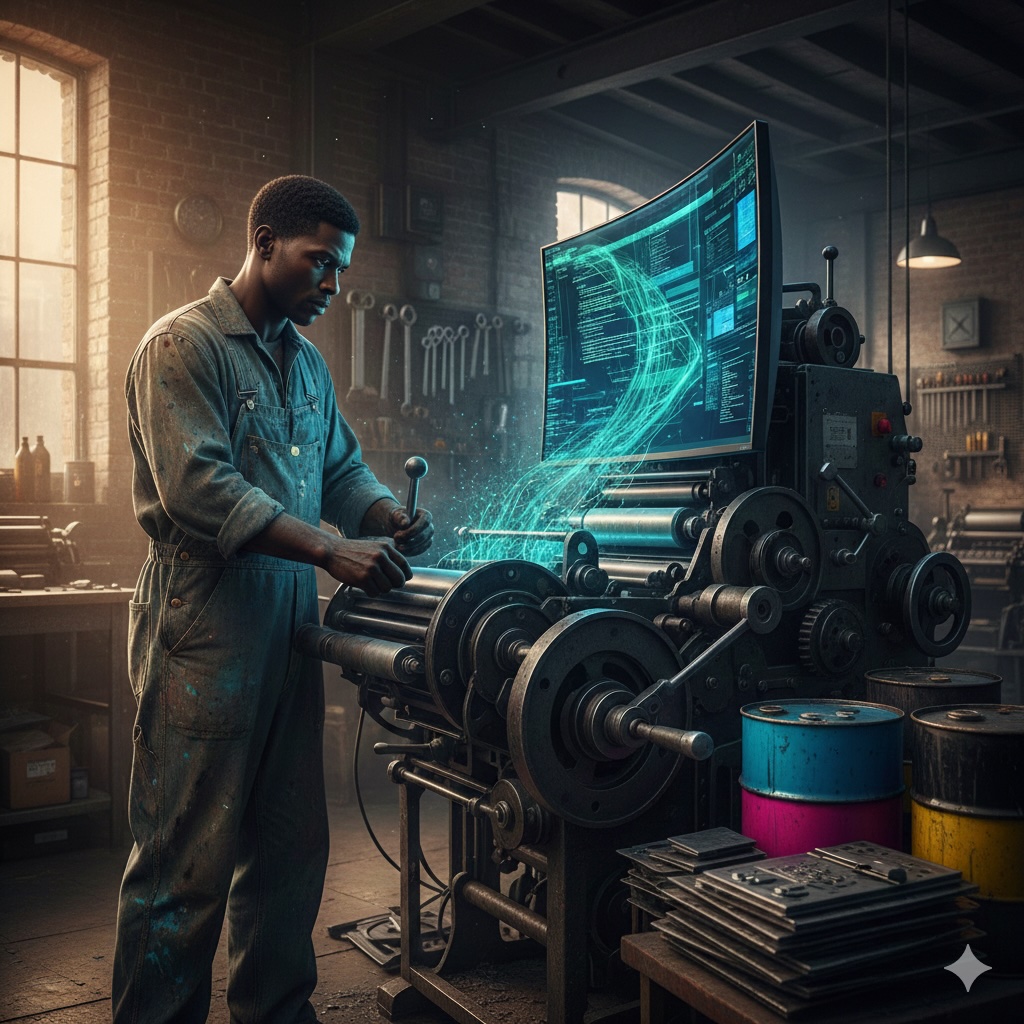
My father has been a printer throughout his adult life. Because of him, I now intuitively understand interesting concepts like desktop publishing, CMYK, colour theory, and why black is never really represented naturally in the environment. But I digress.
The thing about being a printer is you really learn how to mind the machine. I grew up understanding the role of the machine minder in the entire process of enterprise print media. In fact, for a long time, I came to know of Mr Banda, my dad’s right hand man - the machine minder who became integral to my dad’s trade. Throughout the history of this trade - when newspapers and other print publications sold in extraordinary volumes - was the the role Mr Banda played. Often in the background.
In print media, a machine minder is an engineer who is skilled with providing all of the required equipment, configurations, and artifacts to kickstart heavy-duty printing jobs.
The Printing Floor
I remember going to my father’s workplace and seeing these huge machines that had what seemed like dozens of rollers on them, of different sizes. And beneath those rollers were plates, upon which the content was bound. And this had to be handled with great finesse to ensure that the right quantity of ink was deposited on the plate. A different set of rollers deposited water onto the plate to ensure that the non-printing areas stayed clear of ink.
And then they would go to work, working as templates, if you will, or models, from which reams and reams of paper would be inked. And the content upon which the plates were etched would find itself being printed en masse.
What really made this kind of machine special was the sheer velocity at which they would produce these printed artefacts. We’re talking thousands, if not hundreds of thousands of papers. Newspapers, magazines, all sorts of media being churned out by the minute.
Eventually, that would get distributed across countries, to all offices, across all walks of life, where information edited the night before would find itself on desktops and coffee tables the morning after. Breaking news. The backstories. And, of course, lots of adverts.
That’s what my father did for most of his career. He still does to a certain extent, albeit with a nostalgic oversight. More of a hobby than anything else. A hobby that is today more of a relic in the history of information technology.
A Printer’s Son
And here I am today. On the other side of that history. Very much a printer’s son. Very much a PK. One privileged enought to have seen the dying embers of that CMYK era, and the beginning of something much more different, yet similar at the same time.
As I look at where we are in the grand scheme of technology, I see myself as today’s machine minder. Having gone on to pursue softer sciences in the form of computer science, I spent a lot of my own career slapping keys together in orderly fashion to create programs that would then be interpreted by the compiler.
That is a fundamental system in your computer that would translate expertly written instructions into consumer software, or enterprise software, depending on what you were building.
What a joy it’s been, writing these instructions using languages like JavaScript and C and C#. We would master the syntax of these ironically high-level languages, really, and figure out the order in which the compiler would execute them.
But today, that too looks like a lost art. A relic of the past.
The New Machine
Because as I sit now on my computer, no longer writing code as carefully as I was just a few years ago, now I see myself more akin to Mr Banda in his heyday. The guy who feeds the machine with the context that it needs, with the materials that it requires, in the sequence in which they are required. And from there, the machine goes on to loudly generate the media that we then end up consuming.
An exciting time, but a different time nonetheless.
And with nostalgia, I look back at what was a beautiful era of coding. And also, ironically, what is now the era of machine minding. The machine in question, of course, being the large language model. The AI, as it’s more widely referred to.
Today for my full time job, I carefully give the AI the examples that it needs to create what I need it to; the instructions containing all of the decisions we have made thus far, with references to those decisions. As I lay out the folder structure that we would like the newly generated code artifacts to follow; and as carefully load for it all of this context and press the big red button. I sit back, grab a cup of coffee. And watch it generate thousands, if not hundreds of thousands of lines of code in minutes.
This is producing the websites that we interact with today, the games we are playing, the food delivery apps that are bringing hot Pizza to our doorstep, and crucially the Fintech software that’s handling our payments.
I think of myself: I have become my father.
Yet another machine minder.